Environment & Profile Synchronization
Environment & Profile Synchronization
sshs3 provides synchronization tools designed to keep your terminal shell settings and connection profiles synchronized across multiple workstations without compromising privacy or relying on third-party cloud accounts.
1. Dotfiles Pool Sync (Opt-In)
Reconfiguring .bashrc, custom aliases, .vimrc, or .tmux.conf on hundreds of remote servers is tedious. sshs3 offers an opt-in Dotfiles Pool Sync:
Feature: Session-Staged Dotfiles Environment
🎯 Purpose
Deliver a customized, familiar shell environment on every remote server upon login without modifying or polluting permanent server-wide system configuration files.
🛠️ How to Use
- Open Settings → Files & Storage, tick Enable dotfiles pool sync (off by default), and click Manage Dotfile Pools.
- Click Add Files... or drag files in (e.g.
~/.bash_aliases,~/.config/nvim/init.vim). Nothing is added in bulk, so pooling only~/.kube/configmeans picking just that specific file. - You can also right-click any file in the dual-pane file manager and choose Add to Dotfiles Pool....
- Pooled files are displayed grouped by target directory, complete with:
- Read-only preview of file contents. - File Mode (permissions). - Status indicator highlighting whether the local source file has changed on disk since being pooled. Click Refresh to re-read changed source files. - Open Master Directory: Click to open the master pool storage folder directly in your system file manager to edit or reorganize pooled files.
- In any SSH profile under Environment, select the Dotfiles Pool to attach and choose a synchronization policy (e.g. Silent update or interactive diff banner upon connection).
⚠️ Limitations & Caveats
- Pooled files are stored unencrypted on your local workstation. Avoid pooling files that contain unencrypted passwords, private keys, or cloud API tokens.
⚙️ Technical Internals & Architecture
DotfilePoolStore (src/main/dotfiles/DotfilePoolStore.ts) manages pool definitions. Upon SSH connection, a short-lived SFTP check compares files against remote timestamps. Staged files are placed in an isolated temporary session directory and sourced automatically.
2. Remote Profile Synchronization ("Own Your Data")
For operators working across multiple laptops and desktop workstations, sshs3 provides end-to-end encrypted profile synchronization.
Philosophy: "Own Your Data"
sshs3 maintains no central proprietary cloud servers or accounts. You select your own storage backend:
- A private Amazon S3 bucket (or MinIO, Cloudflare R2).
- A private remote SFTP server.
Feature: Zero-Knowledge AES-256-GCM Profile Sync
🎯 Purpose
Synchronize connection profiles, credentials, folders, and application settings across devices with guaranteed zero-knowledge cryptographic privacy against storage providers and network eavesdroppers.
🛠️ How to Use
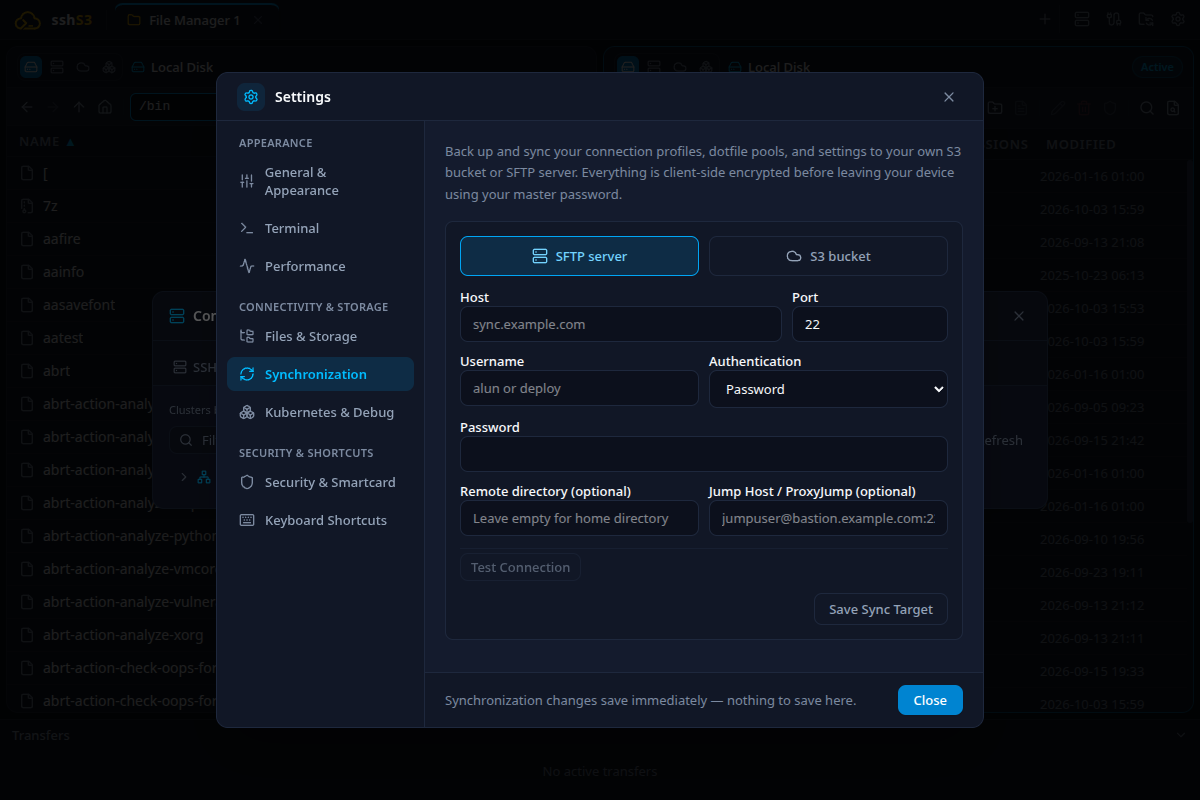
- Open Settings → Synchronization.
- Choose a backend (S3 or SFTP) and enter your target credentials.
- Choose a strong Master Password.
- Advanced: Toggle "Use separate passwords" to maintain separate passwords for topology (hostnames and folders) vs. credentials (passwords, keys, API secrets).
- Smartcard & Hardware Token Unlock (PKCS#11 / SITHS / YubiKey): Choose the smartcard library under Smartcard / Hardware token and click Link smartcard. Later you unlock sync with Unlock with Smartcard and only your smartcard PIN.
⚠️ Limitations & Caveats
- RSA / Ed25519 vs. ECDSA for Key Derivation:
> [!IMPORTANT] > Linking a card so it can derive the master encryption key directly requires an RSA or Ed25519 key. These algorithms sign deterministically, producing the exact same wrapping key upon each unlock. ECDSA cards (common on PIV/CAC) sign with a random nonce each time and cannot reliably derive static keys; for ECDSA, unlock with master passwords once and use the card for session unlocking.
- Tombstones: Deletions record cryptographic tombstones to prevent purged records from re-appearing after multi-device synchronization.
⚙️ Technical Internals & Architecture
Data is encrypted with AES-256-GCM using keys derived via scrypt (N=32768, r=8, p=1). Synchronization executes on a per-record basis reconciled by updatedAt timestamps, preventing independent edits on two workstations from clobbering each other.
3. Managed Block in ~/.ssh/config
Feature: Automatic CLI Configuration Synchronization
🎯 Purpose
Ensure all SSH profiles saved in sshs3 are instantly accessible when running plain ssh commands in external terminal emulators, IDEs, or automated scripts.
🛠️ How to Use
- Under Settings → Terminal, verify Keep ~/.ssh/config in sync with saved SSH profiles is checked.
- Whenever a profile is added or edited, sshs3 updates a managed block in your local
~/.ssh/config:
# BEGIN sshs3 managed block (do not edit manually)
Host prod-db
  HostName 10.0.4.12
  User dbadmin
  Port 22
  IdentityFile ~/.ssh/id_ed25519
  ProxyJump bastion.example.com
# END sshs3 managed block
⚠️ Limitations & Caveats
- Configurations outside the managed block are left completely untouched.
- Directives that execute arbitrary shell code (
LocalCommand,ProxyCommandwith scripts) are stripped for security before writing.
⚙️ Technical Internals & Architecture
SshNativeFileMerger writes atomically using a temporary file (~/.ssh/config.tmp.PID) followed by an atomic rename, eliminating file corruption if the process terminates mid-write.
4. Troubleshooting & Diagnostics Runbook
| Symptom / Error Message | Probable Root Cause | Corrective Action |
|---|---|---|
Wrong master password / MAC mismatch | Incorrect master password entered during unlock | Re-enter password carefully. Three failures trigger a 5-minute security throttle. |
ECDSA key not supported for key derivation | Linked smartcard uses an ECDSA algorithm | Unlock with your master password and use the card for session caching instead. |
Sync conflict detected | Same profile modified concurrently on two devices | Review the conflict resolution dialog to select which version should take precedence. |
| Remote vault corrupted | Incomplete write or network failure during upload | Use "Restore from local backup" in Settings to overwrite the remote vault with your local state. |